

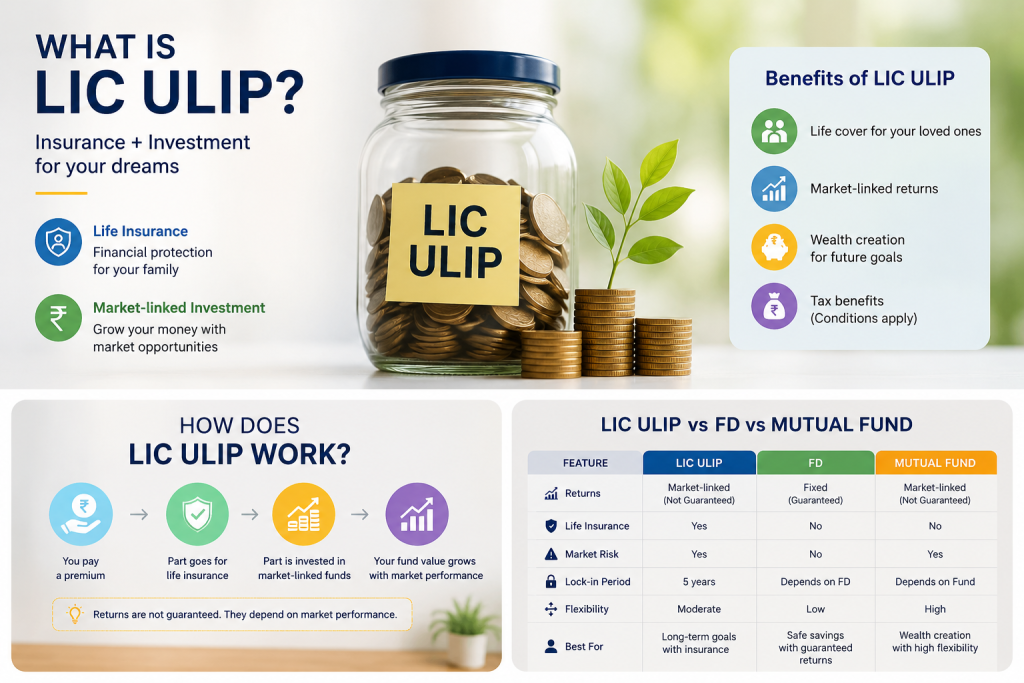
LIC ULIP Plan 2026: Plans, Returns, Charges, Tax & Benefits Explained
If you are looking for an LIC ULIP plan, you probably have a few simple questions:
- What is an LIC ULIP?
- Which LIC ULIP plans are available?
- How much can I invest?
- What returns can I expect?
- Is LIC ULIP better than an FD or mutual fund?
- What are the charges?
- Can I withdraw money?
- Is the maturity amount tax-free?
Let’s answer these questions in simple language.
What is an LIC ULIP plan?
ULIP stands for Unit Linked Insurance Plan.
An LIC ULIP combines two things:
Life insurance + market-linked investment
A part of your premium provides life insurance cover and the money allocated to the investment side is invested in market-linked funds.
So, unlike traditional LIC policies where benefits are generally based on guaranteed benefits, bonuses or other declared additions, a ULIP’s fund value can go up or down depending on the performance of the underlying investments.
Simple example:
If you invest ₹1 lakh in an LIC ULIP, the money is allocated according to the policy rules and investment fund you choose.
If the market performs well, your fund value can increase.
If the market falls, your fund value can also fall.
ULIP returns are therefore not guaranteed.
Which LIC ULIP plans are available?
LIC Protection Plus – Plan 886
Protection Plus is a market-linked LIC plan that provides:
- Life insurance cover
- Market-linked investment
- Choice of investment fund
- Top-up premium facility
- Option to increase or decrease the Sum Assured, subject to conditions
- Partial withdrawal after 5 years
- Regular Pay or Limited Pay options
LIC says the entry age is 18 to 65 years. Policy terms can be 10, 15, 20 or 25 years, with premium-paying terms of 5, 7, 10 or 15 years depending on the policy term.
Important: Always check the latest LIC brochure before buying because product availability and features can change.
Is LIC Index Plus still available?
This is one of the most common questions.
No, Index Plus 873 was withdrawn from sale on 1 October 2024.

It was launched in February 2024 and became quite popular because it offered market-linked investment connected to index-based funds.
Existing policyholders are different from new buyers. If you already have Index Plus, your existing policy continues according to its policy terms.
So don’t buy a plan simply because an old website says:
“LIC Index Plus is the latest LIC ULIP.”
Check the current status first.
Is LIC Nivesh Plus still available?
No.
LIC’s Nivesh Plus was also withdrawn in FY 2024–25.
It was a single-premium ULIP, meaning the policyholder paid a lump sum rather than regular premiums.
You may still find many websites talking about Nivesh Plus because thousands of existing policies continue to remain active.
How does an LIC ULIP make money?
The investment portion of your premium is invested in market-linked funds.
The value of your investment is represented through units and NAV.
If the NAV increases
Your fund value increases.
If the NAV falls
Your fund value falls.
For example:
If you have:
10,000 units × ₹20 NAV = ₹2,00,000 fund value
If NAV becomes ₹25:
10,000 × ₹25 = ₹2,50,000
If NAV falls to ₹17:
10,000 × ₹17 = ₹1,70,000
This is why you should not look at a ULIP like an FD.

What returns can I expect from an LIC ULIP?
There is no fixed return.
This is extremely important.
LIC ULIPs invest in market-linked funds, so the actual return depends on:
- Investment fund
- Market performance
- Investment period
- Charges
- Premium amount
- Policy structure
Therefore, you should not buy an LIC ULIP based on a statement such as:
“You will get 12% guaranteed.”
Market-linked returns are not guaranteed.
The correct way to evaluate a ULIP is to look at the illustration, charges, fund performance and actual policy terms.
LIC also publishes ULIP NAV and periodic disclosures.
LIC ULIP vs FD
| Feature | LIC ULIP | FD |
|---|---|---|
| Returns | Market-linked | Fixed according to FD rate |
| Capital value | Can rise or fall | Generally fixed interest structure |
| Life cover | Yes | No |
| Lock-in | ULIPs have a 5-year lock-in | Depends on FD |
| Market risk | Yes | No market risk |
| Investment horizon | Long term | Short/medium/long term |
| Returns guaranteed? | No | Interest rate is fixed for the deposit |
Simple answer:
If you want fixed and predictable returns, an FD is easier to understand.
If you want market-linked investment + life insurance in one policy, a ULIP may be worth considering.
LIC ULIP vs Mutual Fund
This is a more important comparison.
| Feature | LIC ULIP | Mutual Fund |
|---|---|---|
| Investment | Market-linked | Market-linked |
| Life insurance | Yes | No |
| Lock-in | 5 years | Depends on fund |
| Flexibility | Generally lower | Generally higher |
| Charges | Multiple policy-related charges | Fund-related charges |
| Insurance cover | Included | Not included |
| Investment control | Fund choices within policy | Wide choice of funds |
A mutual fund and a ULIP are not the same product.
If your main objective is investment, you should compare the actual costs and features before choosing.
If you need life insurance, don’t assume that the insurance component of a ULIP is enough for your family’s protection.
For many people, a term insurance policy + separate investment is worth comparing with a ULIP.
What are the charges in an LIC ULIP?
This is one section you should definitely include because many competing articles talk about benefits but don’t make charges easy to understand.
ULIPs can have different types of charges depending on the product.
These may include:
1. Premium allocation charge
A portion of the premium may be deducted before the balance is allocated to the investment.
2. Fund management charge
This is related to managing the investment fund.
3. Policy administration charge
A charge for administering the policy may apply.
4. Mortality charge
This relates to the life insurance cover.
5. Other applicable charges
The exact charges depend on the specific LIC ULIP.
Don’t compare ULIPs only by looking at the expected return.
Look at:
Premium → Charges → Amount invested → Fund value → Insurance cover
That gives you a much clearer picture.
What is the lock-in period of an LIC ULIP?
For individual ULIPs, the regulatory framework provides for a minimum 5-year policy term, and ULIPs have a 5-year lock-in period.
This means you should not buy a ULIP assuming you can freely take your money out after one or two years.
For LIC Protection Plus specifically, LIC states that partial withdrawal is allowed after 5 years.
Therefore:
ULIP = long-term investment
It is generally not suitable for money you may need next year.
Can I withdraw money from an LIC ULIP?
Yes, but the rules depend on the specific plan.
For LIC Protection Plus, LIC states that partial withdrawal is allowed after 5 years, subject to the policy conditions.
Before making a withdrawal, check:
- How much can be withdrawn?
- Minimum withdrawal amount
- Maximum withdrawal allowed
- Number of withdrawals allowed
- Effect on your life cover
- Effect on your fund value
Is LIC ULIP tax-free?
This is an area where you should not simply write “ULIP is tax-free.”
Tax treatment depends on the policy, premium amount, issue date and applicable tax rules.
For ULIPs issued on or after 1 February 2021, the ₹2.5 lakh annual premium threshold is particularly important for the tax treatment of maturity proceeds under Section 10(10D).
So before buying a high-premium ULIP, check the tax treatment applicable to your policy.
Don’t buy a ULIP only because somebody says “ULIP returns are tax-free.”
Is LIC ULIP better than a mutual fund?
There is no one answer.
It depends on what you need.
ULIP may suit you if:
- You want investment + life insurance in one product
- You are comfortable with a long-term commitment
- You understand market risk
- You want a structured investment
- You want access to different investment funds within the policy
A mutual fund may suit you better if:
- Your primary objective is investment
- You want more flexibility
- You want a wider choice of funds
- You already have adequate life insurance
- You want to keep insurance and investment separate
Is LIC ULIP better than an FD?
Again, not automatically.
FDs and ULIPs serve different purposes.
An FD gives you a known interest rate.
A ULIP gives you market-linked investment exposure and life insurance.
So instead of asking:
“Which gives more return?”
ask:
“What am I trying to achieve with this money?”
That is the better question.
Who should consider an LIC ULIP?
An LIC ULIP may be worth considering if you:
✓ Have a long investment horizon
✓ Can stay invested for at least 5 years
✓ Understand market risk
✓ Want insurance and investment together
✓ Don’t need this money immediately
✓ Have compared the charges and benefits
Who should avoid an LIC ULIP?
Think twice if:
✕ You need the money in 1–3 years
✕ You want guaranteed returns
✕ You cannot tolerate market fluctuations
✕ You don’t understand the charges
✕ You are buying only because someone promised a particular return
✕ You need a large amount of life cover
For large life cover, compare a dedicated term insurance plan as well.
LIC ULIP Plan: The simple answer
If you remember only five things, remember these:
1. ULIP means insurance + market-linked investment.
2. Returns are not guaranteed.
3. ULIPs have a 5-year lock-in.
4. Charges matter. Don’t look only at projected returns.
5. Compare a ULIP with term insurance + mutual funds before buying.
Want to know if an LIC ULIP is suitable for you?
Don’t choose a ULIP only because it is an LIC policy.
The right question is:
How much do you want to invest, for how long, and what do you want the money to achieve?
If you want, I can help you compare:
LIC ULIP vs FD vs Mutual Fund vs Term Insurance + Mutual Fund
based on your age, investment amount and time period.
[Get an LIC ULIP Illustration →]
Investment in ULIPs is subject to market risk. Returns are not guaranteed. Please read the policy document and benefit illustration carefully before purchasing
If you’re considering LIC’s current ULIP, read:
[LIC Protection Plus Plan 886 – Complete Guide →]
And if you’re still deciding whether a ULIP is right for you:
[LIC ULIP Plan – Complete Guide →]
Calculate your estimated fund value.
Explore Our LIC ULIP Guides
Simple guides to help you understand LIC ULIPs, Protection Plus, returns and investment options.